Why Methane Wins: The Science of Methalox vs RP-1
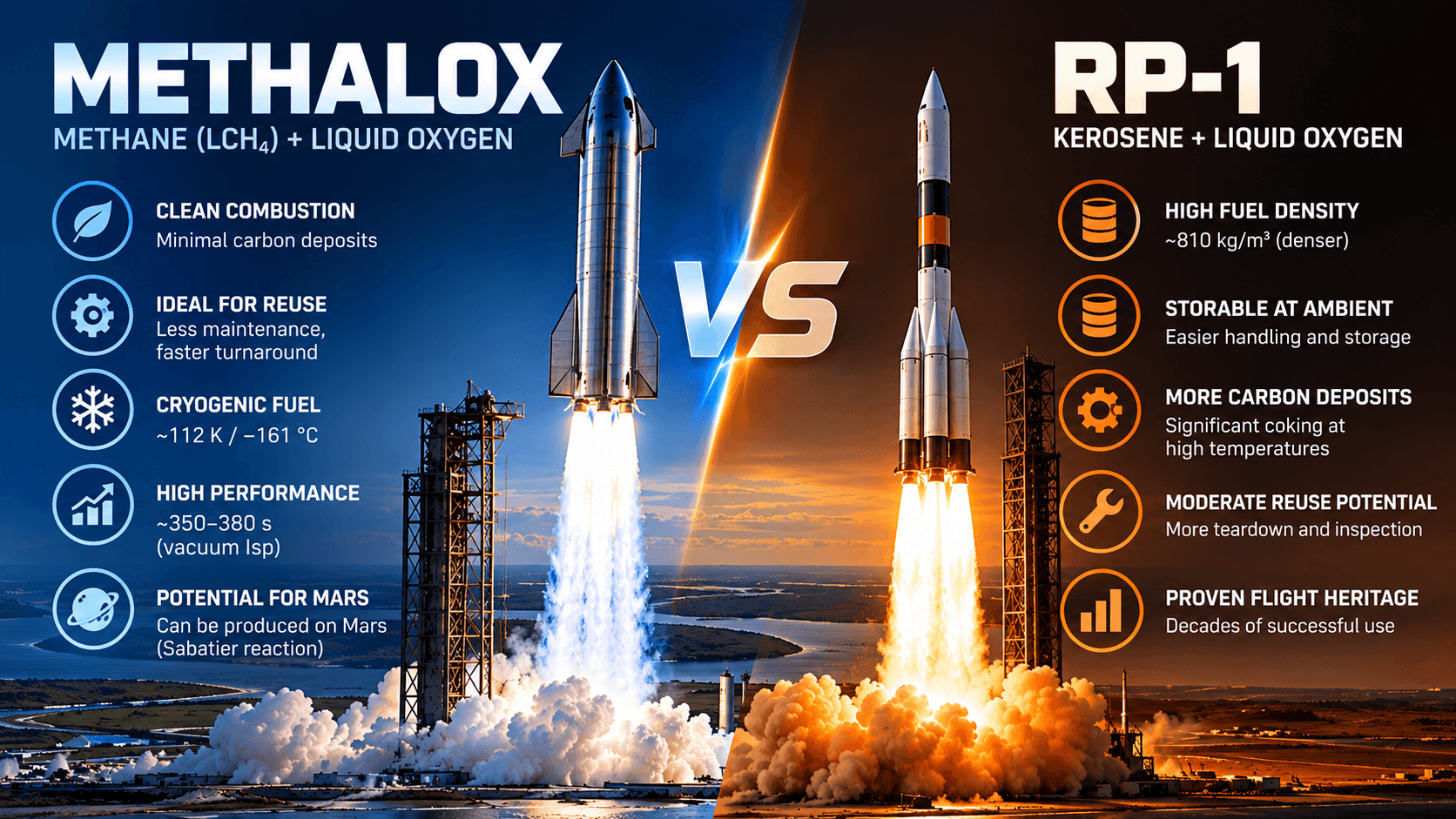
Choosing a rocket fuel is a systems decision, not a contest of single numbers. The fuel sets the size of the tanks, how the engine is cooled, what the ground crew must handle, and — increasingly the deciding factor — how much work an engine needs between flights. Both methane and RP-1 (a highly refined kerosene) are burned with liquid oxygen; the first combination is called methalox, the second kerolox or RP-1/LOX.
For decades, RP-1 was the default hydrocarbon fuel for orbital rockets. But when the design goal shifted from fly once to fly, land, and fly again at low cost, the engineering balance tipped. This article makes the case — grounded in propellant physics and in the engines actually being built today — that for the reusable launch era, methalox is the better choice, and explains precisely why.
The Two Propellants, Side by Side
Before the argument, the data. The table below summarises the fuel-level differences that matter, with approximate figures drawn from published engine and propellant references (sources are listed at the end):
Fuel state
- Methalox: Cryogenic liquid (~112 K / −161 °C)
- RP-1: Storable liquid (ambient temperature)
Fuel density
- Methalox: ~422 kg/m³
- RP-1: ~810 kg/m³ (denser — RP-1 advantage)
Typical vacuum Isp
- Methalox: ~350–380 s
- RP-1: ~340–348 s
Carbon deposits (coking)
- Methalox: Negligible — single-carbon molecule
- RP-1: Significant at high wall temperatures
Cryogenic commonality with LOX
- Methalox: High — LOX boils at ~90 K
- RP-1: None — fuel is stored at ambient
Suitability for reuse
- Methalox: High — clean burn, minimal servicing
- RP-1: Moderate — more teardown / inspection
Off-world production (ISRU)
- Methalox: Yes — Sabatier reaction on Mars
- RP-1: No practical route
Green cells mark the property winner. One row favours RP-1 (density); the rest favour methalox — and the reasons are physical, not incidental.
1. The Decisive Factor: Clean Combustion and Reuse
The single most important advantage of methane is molecular. Methane is CH₄ — one carbon atom bonded to four hydrogens, the simplest hydrocarbon there is. RP-1 is a complex mixture of long-chain hydrocarbons. When kerosene is heated — as it inevitably is when routed through the engine’s regenerative cooling channels at high wall temperatures — those long chains break down and polymerise, leaving behind solid carbon deposits known as coke. Coking narrows cooling passages, fouls injectors, and forces inspection and teardown between firings.
Methane has no long chains to break. It burns and, critically, evaporates cleanly; its decomposition products are gases, not deposits. The result is an engine interior that stays clean across firings — exactly the property a reusable engine needs when it must be hot-fired, inspected, and reflown on a tight cadence.
This does not mean kerosene engines cannot be reused: SpaceX’s RP-1 Merlin has flown reusable Falcon 9 boosters many times. But it is reused in spite of coking, through careful engineering and servicing — not with the clean-burn margin methane provides for free. When the design target is rapid, low-touch reuse, starting from a clean-burning fuel is a structural advantage.
2. A Real — If Modest — Efficiency Edge
Specific impulse (Isp) measures how much thrust an engine extracts per unit of propellant — higher is more efficient. Methane’s advantage here is real but should not be oversold: in broadly comparable engines, methalox delivers a vacuum Isp of roughly 350–380 seconds against roughly 340–348 seconds for RP-1/LOX — an edge of around 10–20 seconds.
The physics behind the edge is the same cleanliness story seen from another angle. Methane’s hydrogen-rich chemistry produces combustion gases of lower average molecular weight, and lighter exhaust leaves the nozzle faster for a given chamber energy, which raises Isp. Ten to twenty seconds sounds small, but because a rocket’s velocity budget depends exponentially on propellant mass, a steady Isp gain compounds meaningfully across an ascent. Cosmicport’s CRYONIX, with a design Isp of 360 seconds, sits squarely in the methalox band.
3. Operational Synergy: One Cryogenic System, Not Two Regimes
This is the advantage that rarely makes headlines but quietly shapes the whole vehicle. Liquid oxygen boils at about 90 K; liquid methane at about 112 K. The two propellants live in nearly the same thermal world. RP-1, by contrast, is stored at ambient temperature while its oxidiser sits at 90 K — two entirely different handling regimes on the same vehicle. Methane’s closeness to LOX unlocks several design conveniences at once:
- Shared thermal systems. Insulation, chill-down, and conditioning hardware can be designed around one narrow temperature range instead of two.
- Common-bulkhead tanks. The fuel and oxidiser tanks can share a wall with modest insulation, shortening and lightening the vehicle — harder to do when one tank is cryogenic and the other ambient.
- Propellant densification. Both propellants can be sub-cooled below their boiling points to pack more mass into the same tank, partially offsetting methane’s lower density.
- Methane as coolant. Because it does not coke, methane can absorb large heat loads in the cooling channels and still reach the injector clean — a role kerosene performs only within tight thermal limits.
4. Cost, Abundance, and a Path Off Earth
Methane is the primary component of natural gas: abundant, inexpensive, and available at high purity with minimal processing. RP-1 is a specialised, tightly specified refinery product that costs more per unit energy. For a launch company flying often, propellant cost and supply simplicity are operational advantages, not footnotes.
There is also a longer horizon. Methane can be synthesised from carbon dioxide and water through the Sabatier reaction — both of which exist on Mars. A methalox architecture is therefore compatible with in-situ propellant production for deep-space missions in a way kerosene simply is not. It is no accident that the vehicles designed with Mars in mind run on methane.
Giving RP-1 Its Due: The Density Trade-off
An honest case names the other side’s strongest point. RP-1’s is density: at roughly 810 kg/m³ it is nearly twice as dense as liquid methane (~422 kg/m³). A denser fuel fits more mass into a smaller tank, which means shorter tanks, less structure, and lower aerodynamic drag — a genuine advantage, especially on first stages where propellant volume dominates the vehicle.
Add RP-1’s ambient storage and decades of flight heritage, and for an expendable vehicle optimised purely for mass-to-orbit, kerolox remains a perfectly rational choice. But density buys a one-time structural saving, while coking, servicing, and propellant cost are paid every single flight. For a vehicle meant to fly dozens of times, the recurring advantages of methane outweigh the one-time advantage of kerosene — and densification narrows even the density gap.
The Industry Has Already Voted
The clearest evidence is what the world’s engineers are actually building. In July 2023, LandSpace’s Zhuque-2 became the first methalox rocket to reach orbit — and almost every clean-sheet reusable engine of the past decade burns methane:
- SpaceX Raptor (Starship) — full-flow staged-combustion methalox
- Blue Origin BE-4 (New Glenn, ULA Vulcan) — methalox, replacing RP-1 heritage engines
- Rocket Lab Archimedes (Neutron) — methalox, chosen specifically for reuse
- LandSpace Zhuque, and ESA’s Prometheus demonstrator — methalox
When nearly every organisation designing a new reusable engine independently arrives at the same propellant, that convergence is not fashion — it is the physics above, expressed as engineering decisions. RP-1 persists mostly in legacy engines designed in an expendable era; methane is the fuel of the engines being designed now.
Where CRYONIX Fits
Cosmicport’s CRYONIX is a methane–liquid-oxygen engine built on a gas-generator cycle, developed around the advantages set out above: clean combustion for reuse, a competitive Isp, and thermal commonality with its oxidiser.
CRYONIX — design specifications (targets, subject to test verification)
- Propellant Liquid methane (LCH₄) + liquid oxygen (LOX)
- Thrust class 100 kN
- Cycle Gas-generator (open) cycle
- Design specific impulse 360 s — within the typical methalox band
Figures above are published design targets, not test-verified results. CRYONIX is one of a growing international cohort of methalox engines — and it is built on the same reasoning that led the rest of the industry to methane.
The Verdict
RP-1 is not obsolete, and “best” always depends on the mission. But the mission that defines modern launch — reusable, high-cadence, cost-driven access to orbit — rewards exactly the properties methane has and kerosene lacks: clean combustion, thermal kinship with oxygen, low cost, and a competitive efficiency edge. RP-1’s density advantage is real, but it is a one-time saving set against advantages methane delivers on every flight.
For the rockets being designed today, the science points one way — and the industry has followed it. Methalox is the right fuel for the reusable era, and CRYONIX is built on that conviction.
Quick Questions
Is methalox more efficient than RP-1?
Modestly, yes — roughly 10–20 seconds more vacuum Isp in comparable engines, because methane’s hydrogen-rich combustion yields lighter, faster exhaust. The larger wins are in reuse and operations.
Does methane automatically make a rocket reusable?
No — reuse depends on the whole engine. But methane’s clean, coke-free combustion removes one of the biggest obstacles to rapid, low-cost reuse, which is why new reusable engines favour it.
What is RP-1’s genuine advantage?
Density. RP-1 is about twice as dense as liquid methane, allowing smaller tanks and lighter structure — valuable for expendable, mass-optimised vehicles.
Why does methane pair so well with liquid oxygen?
Their boiling points are close (~112 K vs ~90 K), so they share thermal-management hardware, enable common-bulkhead tanks, and can both be densified — simplifying the whole vehicle.
Sources
Explore Cosmicport
Explore Cosmicport's launch vehicle and propulsion technologies.