Gas Generator vs Staged Combustion: The Engineering Evidence Behind Rocket Engine Cycles
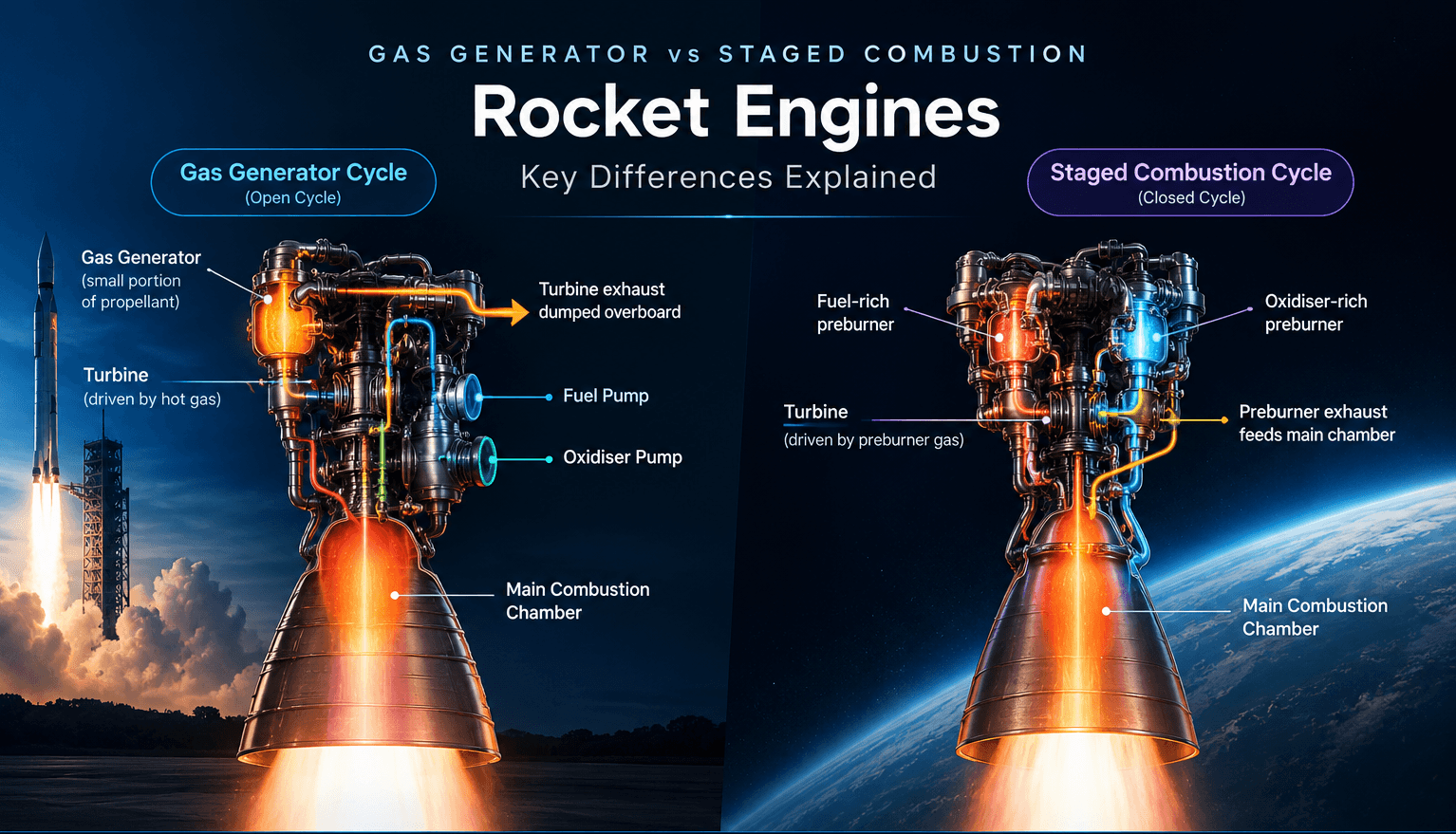
A rocket engine does more than burn propellant. In most high-performance liquid engines, a turbine drives the pumps that force fuel and oxidiser into the combustion chamber at enormous pressure. How that turbine is powered — and what becomes of its exhaust — defines the engine’s power cycle, and it is one of the most consequential choices an engine designer makes. The two dominant architectures are the gas-generator cycle and the staged-combustion cycle.
Both have powered some of the most successful rockets ever flown, so neither is simply “better.” The differences become concrete — and measurable — when engineers weigh specific impulse, chamber pressure, development cost, reliability, and reusability. This article explains how each cycle works and sets the trade-offs against the evidence of real engines.
What Is a Rocket Engine Power Cycle?
A liquid engine stores fuel and oxidiser in separate tanks, and turbopumps move them into the chamber, where they react to produce hot, high-pressure gas that the nozzle expands into thrust. But the pumps themselves need power, and that power comes from the propellant. The power cycle is the scheme by which an engine taps a portion of its own propellant to spin the turbine — and how it handles the flow afterwards. That single decision ripples through propellant efficiency, achievable chamber pressure, component temperatures, and the number of punishing operating conditions the design must survive.
How a Gas-Generator Cycle Works
A gas-generator (or “open”) engine burns a small fraction of its propellant in a separate, auxiliary combustor — the gas generator. The hot gas this produces spins the turbine that drives the pumps, and is then exhausted overboard, usually through a dedicated duct, rather than passing into the main chamber. The large remainder of the propellant flows to the main chamber to produce nearly all the thrust. The flow runs like this:
- Fuel and oxidiser leave the tanks and enter the pumps.
- A controlled fraction is diverted to the gas generator and burned.
- The gas-generator exhaust spins the turbine, powering the pumps.
- The bulk of the propellant burns in the main chamber; the turbine exhaust exits separately.
Because that turbine exhaust never expands fully through the main nozzle, an open cycle gives up a small slice of efficiency. In return it keeps the turbine circuit and the main chamber cleanly separated, which makes the engine simpler to design, test, and qualify. It is the cycle behind the Rocketdyne F-1 that launched the Saturn V and SpaceX’s Merlin 1D — proof that an open cycle can anchor both the most powerful and the most frequently flown rockets in history.
How a Staged-Combustion Cycle Works
In a staged-combustion (or “closed”) engine, a preburner partially combusts the propellants to generate turbine-driving gas — and then, instead of discarding that gas, the engine routes it onward into the main chamber, where combustion is completed. The turbine flow therefore contributes to the main thrust stream; essentially none of the propellant’s energy is thrown away.
The preburner can run fuel-rich (as in the Space Shuttle’s RS-25) or oxidiser-rich (as in the Russian RD-180), and the most advanced designs use both. SpaceX’s Raptor is a full-flow staged-combustion engine — two preburners, one fuel-rich and one oxidiser-rich — and the first engine of that type ever to fly. Recovering the turbine exhaust lets these engines reach very high chamber pressures and strong efficiency, but it tightly couples every subsystem and places extreme demands on materials, seals, and combustion stability — especially where hot, oxygen-rich gas must pass through turbine hardware without igniting it.
Gas Generator vs Staged Combustion: Side by Side
The broad engineering tendencies, with representative engines for each cycle:
1. Turbine Exhaust
Gas-generator cycle (open): Dumped overboard — bypasses the main nozzle.
Staged-combustion cycle (closed): Routed into the main chamber — nothing wasted.
2. Typical Chamber Pressure
Gas-generator cycle (open): ~70–120 bar.
Staged-combustion cycle (closed): ~200–300 bar.
3. Specific Impulse
Gas-generator cycle (open): Slightly lower — turbine flow is lost.
Staged-combustion cycle (closed): Higher — all propellant does useful work.
4. Development & Hardware
Gas-generator cycle (open): Simpler, more robust, faster to qualify.
Staged-combustion cycle (closed): Demanding materials, seals, and controls.
5. Representative Engines
Gas-generator cycle (open): F-1 (Saturn V), Merlin 1D, Vulcain 2.
Staged-combustion cycle (closed): RS-25, RD-180, Raptor, BE-4.
6. Best Fit
Gas-generator cycle (open): Cost, schedule, and robustness priorities.
Staged-combustion cycle (closed): When peak performance justifies complexity.
Tendencies, not guarantees — real performance depends on propellants, nozzle expansion, cooling, operating point, and the vehicle as a whole.
The Evidence: Chamber Pressure and Specific Impulse
The clearest fingerprint of the two cycles is chamber pressure. Gas-generator engines typically operate in the region of 70–120 bar: the F-1 ran near 70 bar, the Merlin 1D around 97 bar. Staged-combustion engines climb far higher — the RS-25 to roughly 206 bar, the RD-180 to about 267 bar, and Raptor to around 300 bar, among the highest ever flown. Higher chamber pressure allows a more compact, higher-performing thrust chamber, but it sharply raises the load on pumps, injectors, seals, and cooling — which is exactly what the closed cycle is built to supply and the open cycle deliberately avoids.
The efficiency gap shows up in specific impulse (Isp) — the measure of thrust produced per unit of propellant. Comparing two kerosene engines makes it concrete: the gas-generator Merlin 1D delivers about 311 s in vacuum, while the staged-combustion RD-180 reaches roughly 338 s. The difference is modest and the two engines differ in many ways, but the direction is consistent: routing turbine exhaust back into the chamber recovers propellant energy that an open cycle vents away. The cycle alone never fixes the final number, though — propellant choice, mixture ratio, and nozzle expansion all move it. (See our companion article on specific impulse for how these factors combine.)
Complexity, Reliability, and Reusability
It is tempting to file gas-generator engines under “simple” and staged-combustion under “advanced,” but both are formidably complex machines. Reliability is earned through engineering margins, component qualification, controls, inspection, and repeated test firing — not by the cycle name. What the open cycle offers is a more accessible path: keeping the turbine exhaust outside the main chamber decouples the hardest interactions, which shortens development and reduces risk. The closed cycle recovers more energy but introduces severe preburner and turbine conditions and far tighter coupling between subsystems.
For reusable engines, both cycles must additionally answer for thermal cycling, component life, maintainability, and turnaround — considerations that sit on top of the cycle choice rather than being settled by it.
Why CRYONIX Uses a Gas-Generator Cycle
Cosmicport’s CRYONIX is a methalox engine built on a gas-generator cycle — and the reasoning follows directly from the evidence above. For a first flight engine, the open cycle’s advantages are decisive: it is simpler to design and instrument, more forgiving to test, faster to qualify, and backed by the deepest flight heritage of any cycle, from the F-1 to the Merlin. The few seconds of Isp it concedes to staged combustion are a deliberate, well-understood trade for robustness and development speed — while leaving a clear path to higher-performance cycles in later engine generations.
CRYONIX — cycle context (design information, subject to test verification)
- Propellant Liquid methane (LCH₄) + liquid oxygen (LOX)
- Power cycle Gas-generator (open) cycle
- Rationale Robustness, testability, and development speed for a first flight engine
- Application Propulsion for the MACH BLUE small-lift launch vehicle
The gas-generator architecture is a stated design choice; detailed performance figures are design targets subject to test verification. For the broader propulsion picture, see our article on how methane rocket engines work.
So Which Cycle Is Better?
The honest answer is that the question is the wrong one. Staged combustion is the stronger choice when a mission demands maximum performance and the program can absorb a long, demanding development effort. A gas-generator cycle is the rational choice when robustness, schedule, and a manageable risk profile matter more — which, for most first-generation and small-lift vehicles, they do. The decision also turns on propellant chemistry, vehicle mass, production capacity, and test infrastructure. The useful question is not “which cycle wins?” but “which cycle best serves this vehicle and its mission?”
Frequently Asked Questions
Is a gas-generator engine less efficient than staged combustion?
Slightly, yes — it vents its turbine exhaust instead of burning it in the main chamber, giving up a small amount of specific impulse. The size of the penalty depends on the specific design.
Does staged combustion burn propellant twice?
Not literally. A preburner partially reacts the propellants to drive the turbine; the remaining chemical energy is then released in the main chamber. The propellant is used once, more completely.
What is full-flow staged combustion?
A staged-combustion variant with two preburners — one fuel-rich, one oxidiser-rich — so that essentially all propellant passes through a turbine before reaching the chamber. SpaceX’s Raptor is the first such engine to fly.
Can a gas-generator engine be reusable?
Yes. Reusability depends on thermal margins, component life, inspection and maintenance, and qualification testing — not on the power cycle alone.
Do all methane engines use staged combustion?
No. Methane and liquid oxygen work with any cycle; propellant choice and cycle choice are related but separate decisions. CRYONIX, for example, pairs methalox with a gas-generator cycle.
Technical References
- Sutton & Biblarz, Rocket Propulsion Elements (Wiley) — engine power cycles and performance.
- Staged combustion cycle — overview and engine examples (Wikipedia)
- SpaceX Merlin — gas-generator cycle, ~97 bar chamber pressure (Wikipedia)
- RD-180 — oxidiser-rich staged combustion, ~267 bar (Wikipedia)
- RS-25 — fuel-rich staged combustion, ~206 bar (Wikipedia)
- SpaceX Raptor — full-flow staged combustion, ~300 bar (Wikipedia)
- NASA Glenn — Beginner’s Guide to Propulsion
Explore Cosmicport
Explore Cosmicport's launch vehicle and propulsion technologies.