MACH BLUE: The Small-Lift Launch Vehicle Poised to Rewrite the Economics of Orbit
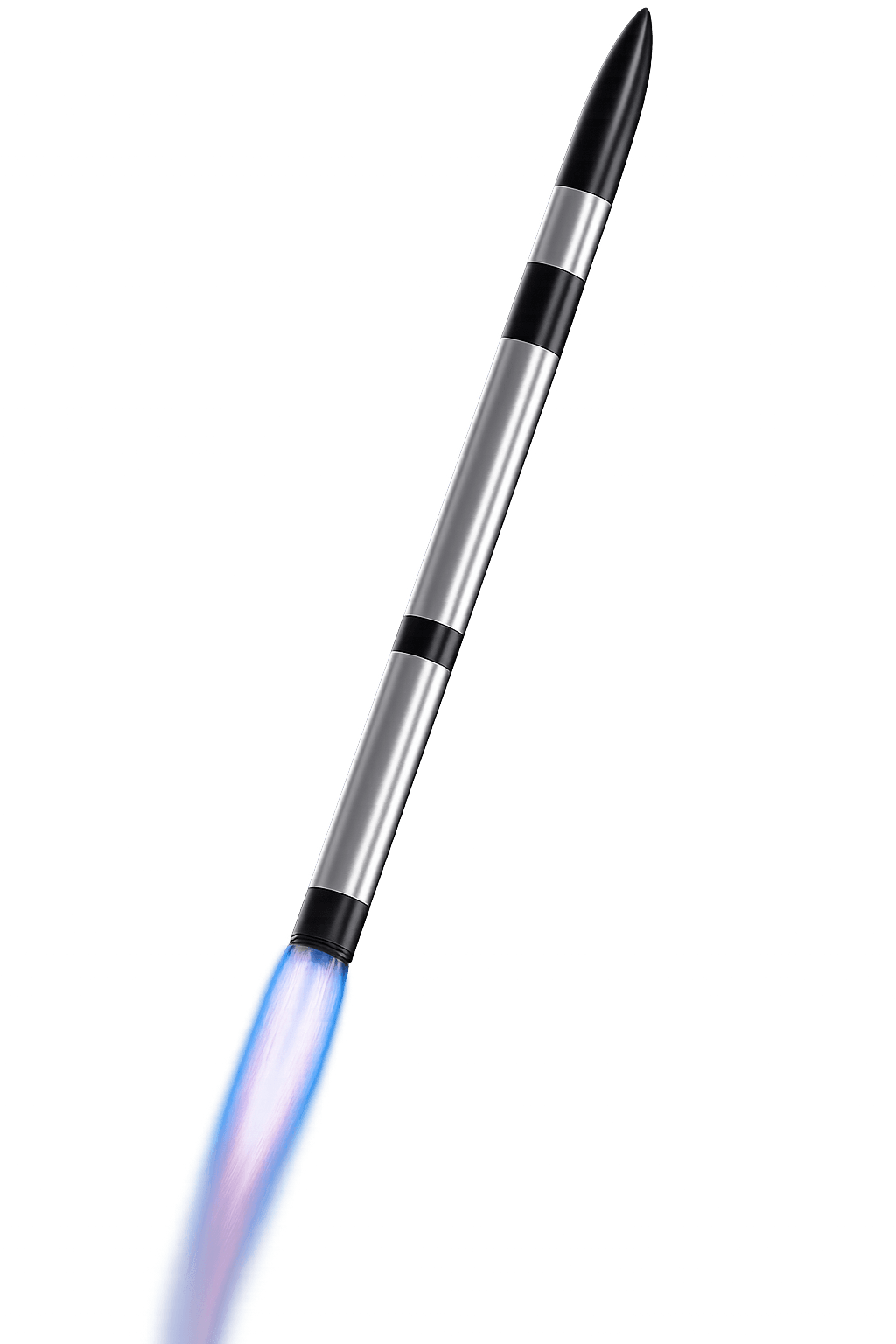
The small-satellite industry has a launch problem, and it is not a shortage of rockets it is a shortage of affordable, dedicated ones. Operators today face a hard choice: pay a steep premium for a dedicated small-lift vehicle that flies where and when they need, or accept the low per-kilogram price of a rideshare and surrender control of their schedule and their orbit. MACH BLUE, Cosmicport’s methalox small-lift launch vehicle, is being built to collapse that trade-off to deliver dedicated launch at a price per kilogram that today only rideshare can match.
MACH BLUE at a Glance
MACH BLUE is a two-stage, small-lift orbital launch vehicle built around Cosmicport’s in-house CRYONIX methalox engine. It is designed for both dedicated and rideshare small-satellite missions, and it flies in two configurations that trade reusability against maximum payload.
MACH BLUE — published design specifications
• Payload to LEO Up to 1,200 kg (500 km, expendable configuration)
• Payload to SSO Up to 600 kg (500 km, reusable configuration)
• First-stage propulsion Nine CRYONIX methalox engines
• Total liftoff thrust ~ 900 kN (9 × 100 kN)
• Propellant Liquid methane (LCH₄) + liquid oxygen (LOX)
• Missions Dedicated and rideshare small-satellite deployment
• Target launch site Kulasekarapattinam, Tamil Nadu, India
• Target price ~ $6,000 / kg
The Propulsion Architecture: Nine CRYONIX Engines
MACH BLUE’s first stage is powered by a cluster of nine CRYONIX engines, each in the 100 kN thrust class, for roughly 900 kN of total thrust at liftoff. CRYONIX burns methalox on a gas-generator cycle with a design specific impulse of 360 seconds. Clustering nine copies of a single, well-characterised engine rather than developing one large bespoke engine is a deliberate architectural choice with three compounding advantages:
- Engine-out redundancy. With nine engines, the vehicle can lose an engine in flight and still reach orbit by burning the remaining eight longer a resilience a single-engine stage cannot offer.
- Thrust-vector control. Gimballing and differentially throttling individual engines across the cluster gives precise steering during ascent and, in the reusable configuration, the fine control needed for a propulsive landing.
- Manufacturing economics. Building many identical 100 kN engines drives a fast production learning curve, higher build rates, and lower unit cost than one-off large engines the same economic logic that reshaped modern launch, applied at small-lift scale.
The choice of methalox is what makes this architecture practical. Methane burns cleanly without the carbon deposits that foul reusable hardware, ignites reliably from a spark for restart and landing, and is dense enough to keep the vehicle compact. (For the full propulsion picture, see our companion articles on methalox propulsion and on specific impulse and CRYONIX.)
Two Configurations: Reusable and Expendable
MACH BLUE is designed to fly in two modes, letting a customer pick the point on the reusability-versus-payload curve that fits their mission:
- Reusable configuration — up to 600 kg to Sun-Synchronous Orbit. Here the first stage is recovered and reflown, trading some payload mass for the propellant and hardware margins that recovery demands. This is the workhorse mode for Earth-observation and SSO constellation missions, where launch cadence and cost matter most.
- Expendable configuration — up to 1,200 kg to Low Earth Orbit. When a mission needs maximum performance, flying expendable frees the mass otherwise reserved for recovery, roughly doubling the payload to LEO.
Methalox is the enabler of both: its clean combustion and spark restart make the reusable mode achievable, while its density and efficiency keep the expendable mode compact and capable.
The Economics: Why $6,000 per Kilogram Changes the Game
The heart of MACH BLUE’s case is price. To see why a $6,000/kg target is disruptive, it helps to look at what small-satellite operators pay today. The market splits cleanly into two models, each with a defining weakness (figures below are approximate, based on publicly reported pricing):
- Dedicated small-lift gives the operator full control of schedule and orbit — but at a steep price. Rocket Lab’s Electron, the benchmark dedicated small launcher, runs roughly $7.5 million for about 300 kg to LEO, or on the order of $25,000 per kilogram.
- Rideshare is far cheaper per kilogram SpaceX’s Transporter missions floor around $6,000–6,500 per kilogram but the operator rides on the primary payload’s terms, launching on its schedule and dropping off in its orbit, then using its own propulsion to reach the intended one.
The pattern is clear: today, an operator can have dedicated control or low per-kilogram cost, but not both. Cosmicport’s target of ~$6,000/kg for a dedicated MACH BLUE launch is aimed precisely at that gap — bringing rideshare-class economics to a vehicle that still flies the customer’s schedule to the customer’s orbit. In practical terms, that puts a dedicated 600 kg SSO mission on the order of $3.6 million, and a full 1,200 kg LEO mission near $7.2 million — dedicated performance at a price that has, until now, meant giving up control.
Reusability is what makes that price structurally sustainable rather than a temporary discount. Recovering and reflying the nine-engine first stage spreads the single largest hardware cost across multiple flights, and the clean-burning methalox propellant is central to making that reuse routine.
Launching from Kulasekarapattinam: A Geographic Advantage
MACH BLUE is targeted to fly from Kulasekarapattinam, the new spaceport taking shape on the southern coast of Tamil Nadu, in Thoothukudi district. Developed as India’s second launch site and purpose-built for small-lift and commercial small-satellite missions, Kulasekarapattinam is intended to complement the country’s established range at Sriharikota with a facility optimised specifically for the small end of the market MACH BLUE serves.
Its value to an SSO-focused vehicle is fundamentally geographic. Sitting near the southern tip of the Indian peninsula, Kulasekarapattinam allows rockets to fly straight south over open ocean — the natural trajectory for the polar and Sun-Synchronous orbits that dominate Earth-observation and small-satellite demand. Launches to those orbits from Sriharikota, further north on the east coast, must perform a fuel-consuming dog-leg manoeuvre to steer clear of Sri Lanka’s landmass — a detour that eats directly into deliverable payload. A straight southerly launch from Kulasekarapattinam avoids that penalty, so a larger share of the vehicle’s performance reaches orbit as usable payload.
For Cosmicport, whose operations are based in the same Thoothukudi region, the combination is difficult to beat: a dedicated small-lift spaceport, an efficient trajectory to the most in-demand orbits, and proximity to the company’s own facilities. Together, they make Kulasekarapattinam a natural home for MACH BLUE — and a structural advantage designed into the program from the launch pad up.
What Is a Small-Lift Launch Vehicle?
Having seen how MACH BLUE is built, it is worth stepping back to the vehicle class it belongs to. A small-lift launch vehicle (SSLV) is an orbital rocket sized to carry relatively small payloads — typically from a few hundred kilograms up to roughly 1–1.5 tonnes — to Low Earth Orbit and other common destinations such as Sun-Synchronous Orbit.
Unlike medium- and heavy-lift rockets built to loft many tonnes, small-lift vehicles are optimised around smaller missions: individual small satellites, technology demonstrations, Earth-observation spacecraft, research payloads, and the incremental deployment and replenishment of satellite constellations. The design goal is not raw mass to orbit but the right mass, to the right orbit, on the right schedule, affordably.
Why Small-Lift Vehicles Matter: Dedicated vs Rideshare
Historically, small-satellite operators have often flown as secondary payloads aboard larger rockets. Rideshare can be an economical route to orbit, but the primary mission sets the launch date and the destination orbit. A dedicated small-lift vehicle changes that relationship. Depending on the mission, its advantages can include:
- Control over launch scheduling rather than waiting on a primary payload
- Mission-specific orbits, reached directly instead of via costly self-transfer
- Dedicated launch opportunities for time-sensitive deployments
- Constellation deployment on the operator’s own cadence
- Reduced dependence on another mission’s timeline and manifest
Neither model is universally better. The right choice depends on payload mass, schedule, target orbit, integration needs, and overall mission economics — which is exactly why a vehicle that narrows the price gap between the two, as MACH BLUE aims to, expands the options available to the whole market.
What Makes an Effective Small-Lift Vehicle
Building an effective small-lift vehicle is not a matter of shrinking a large rocket. Several systems have to work together:
- Propulsion. Engine thrust, propellant choice, efficiency, and reliability set the ceiling on what the vehicle can do. Modern small-lift programs increasingly favor methalox for its balance of efficiency, density, and suitability for reusable operation — the reasoning behind CRYONIX.
- Payload capability. Capacity varies significantly with target orbit, altitude, and inclination, so a vehicle is best understood by its performance to specific orbits rather than a single headline number.
- Mission flexibility. Different operators need different orbits and schedules; an effective vehicle balances payload capability against operational flexibility.
- Launch operations. Efficient manufacturing, integration, testing, and launch preparation determine how responsively a provider can serve a changing manifest — and, ultimately, its cost per flight.
The Future of Small-Satellite Launch
Satellites are getting smaller and more numerous, and launch demand is becoming more diverse. Heavy-lift rockets will remain essential for high-capacity missions, but a growing share of the market — Earth observation, communications, research, and constellations — needs flexible, dedicated, affordable access to specific orbits. That is the need small-lift vehicles exist to meet.
MACH BLUE is Cosmicport’s answer to it: a methalox small-lift vehicle, powered by nine in-house CRYONIX engines, engineered so that dedicated launch no longer has to cost a premium. If the $6,000/kg target holds through development and flight, MACH BLUE will not just enter the small-lift market — it will help redraw its economics.
Explore Cosmicport
Explore Cosmicport's launch vehicle and propulsion technologies.