How Methane Rocket Engines Work: The Science Inside Methalox Propulsion
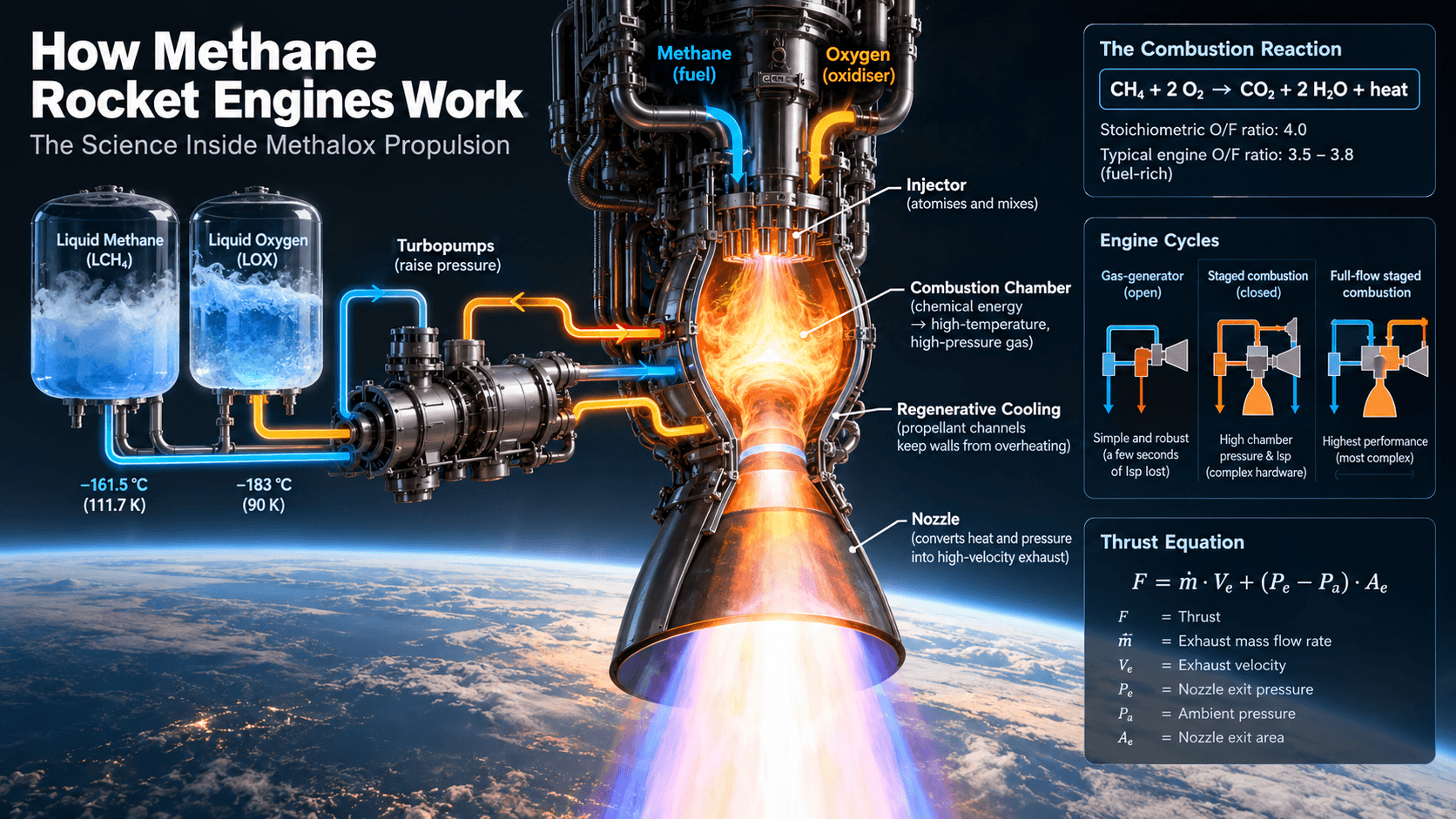
Liquid-propellant rocketry is in the middle of a shift. For decades the hydrocarbon fuel of choice was refined kerosene (RP-1); today, almost every clean-sheet engine designed for reuse burns methane instead. A methane rocket engine pairs methane fuel with an oxidiser — almost always liquid oxygen (LOX) — to produce the high-temperature, high-pressure gas that becomes thrust. The pairing is called methalox.
What Is a Methane Rocket Engine?
A methane rocket engine is a chemical propulsion system that burns liquid methane (LCH₄) with liquid oxygen, both stored as cryogenic liquids. Inside the combustion chamber the two react, releasing chemical energy as heat; the resulting gas is accelerated through a nozzle into a high-velocity exhaust. The simplified complete-combustion reaction is:
CH₄ + 2 O₂ → CO₂ + 2 H₂O (+ heat)
That 1-to-2 molecular ratio corresponds to a stoichiometric oxidiser-to-fuel (O/F) mass ratio of 4.0. Real engines run deliberately fuel-rich, typically around O/F 3.5–3.8, which holds the peak flame temperature — otherwise near 3,500 K (≈3,200 °C) — below what the hardware can survive, and lightens the exhaust to improve efficiency. Because the rocket carries its own oxidiser, it works identically in the vacuum of space, where an air-breathing jet cannot.
The Main Components
However they differ in detail, pump-fed methane engines share the same functional chain:
- Propellant feed systems — tanks, lines, and valves delivering methane and LOX.
- Turbopumps — raise propellant pressure from a few bar in the tanks to the high pressure the chamber demands.
- Injector — atomises and mixes the two propellants as they enter the chamber; the single biggest influence on combustion stability.
- Combustion chamber — where the reaction is contained and sustained.
- Regenerative cooling — channels that carry propellant around the chamber and nozzle to keep the walls intact.
- Nozzle — the converging–diverging bell that turns heat and pressure into directed velocity.
- Ignition and control — spark or torch ignition plus the valves and sequencing that manage startup, throttle, and shutdown.
How Methane and Oxygen Produce Thrust
The process runs in four tightly sequenced stages:
- Cryogenic storage. Methane is a liquid only below about −161.5 °C (111.7 K); oxygen below about −183 °C (90 K). Insulation and tank-pressure control keep both liquid — and because the two boiling points are so close, they can share much of the same thermal-management hardware.
- Pressurisation and delivery. Turbopumps drive the propellants to the injector at high pressure, with flow held stable through the violent transients of start-up and shutdown.
- Injection and combustion. The injector mixes the streams; chemical energy becomes thermal energy, producing hot, high-pressure gas. Uneven mixing or pressure oscillation here is a leading cause of engine failure, which is why injector design is so central.
- Nozzle expansion. The converging–diverging nozzle converts that thermal energy and pressure into a directed, supersonic exhaust. By conservation of momentum, the engine is pushed the opposite way.
Thrust is captured by the rocket thrust equation:
F = ṁ•Ve + (Pe − Pa)•Ae
where F is thrust, ṁ the exhaust mass flow rate, Ve the exhaust velocity, and the final term is the pressure thrust from the difference between nozzle-exit pressure Pe and ambient pressure Pa over the exit area Ae. The pressure term is why the same engine produces more thrust — and higher efficiency — in vacuum than at sea level.
Engine Cycles: How the Pumps Are Powered
The power cycle — how the turbopumps are driven — is one of the defining choices in any liquid engine. Three cycles dominate methane propulsion:
1. Gas-generator (open)
How the turbine is driven: A small bleed of propellant burned in a separate gas generator.
Turbine exhaust: Dumped overboard (not through the main chamber).
Trade-off: Simplest and most robust; a few seconds of Isp lost.
2. Staged combustion (closed)
How the turbine is driven: A preburner drives the turbine, then the flow continues on.
Turbine exhaust: Routed into the main chamber — nothing wasted.
Trade-off: High chamber pressure & Isp; complex, high-pressure hardware.
3. Full-flow staged combustion
How the turbine is driven: Two preburners — one fuel-rich, one oxidiser-rich.
Turbine exhaust: Both streams enter the main chamber.
Trade-off: Highest performance; the most complex cycle to build.
These are not theoretical. SpaceX’s Raptor, a full-flow staged-combustion methane engine, runs at roughly 300 bar chamber pressure — among the highest of any engine ever flown. Blue Origin’s BE-4 uses an oxidiser-rich staged-combustion cycle at around 134 bar. The gas-generator cycle sits at the other end of the spectrum: lower chamber pressure and a few seconds less Isp, but far simpler, more robust, and faster to develop — which is why it remains the pragmatic choice for a first flight engine. Cycle choice follows the mission and the program’s risk appetite, not the fuel alone.
Regenerative Cooling: Surviving the Heat
Combustion gas near 3,500 K is far hotter than any chamber alloy can withstand — steel melts below 1,800 K. The dominant solution is regenerative cooling: before it is burned, cold propellant is routed through narrow channels built into the chamber and nozzle walls, absorbing heat and carrying it away so the structure stays within its limits. The heat is not wasted — it is returned to the propellant, slightly raising performance.
Methane is an unusually good regenerative coolant, and the reason is chemical. Kerosene, pushed to high channel-wall temperatures, breaks down and leaves solid carbon deposits (“coking”) that choke the passages. Methane, a single-carbon molecule, does not polymerise that way, so it can absorb a large heat load and still arrive at the injector clean. That matters most for reuse: every firing subjects the engine to a full cycle of thermal, pressure, and vibration loads, and clean cooling passages are what let those cycles repeat without a teardown. Cooling alone does not make an engine reusable — fatigue life, seals, turbomachinery, and inspection all matter — but it is a precondition.
Why Methane Suits Reusable Engines
Three properties, all rooted in physics, explain methane’s rise:
- Clean combustion. As above, methane’s simple CH₄ structure burns without the carbon deposits that complicate kerosene reuse — the decisive operational advantage for engines meant to fly repeatedly.
- A balanced density–efficiency position. Liquid hydrogen offers the highest specific impulse but is extremely low density (~71 kg/m³), forcing enormous insulated tanks. Kerosene is dense (~810 kg/m³) but less efficient. Methane (~422 kg/m³) sits between them — competitive efficiency without hydrogen’s bulk.
- Thermal kinship with LOX. With boiling points only ~22 K apart, methane and oxygen share cooling systems, enable common-bulkhead tanks, and can both be densified — simplifying the whole vehicle.
For the full fuel-versus-fuel comparison, see our companion article, “Why Methane Wins: The Science of Methalox vs RP-1.”
Specific Impulse and Methane-Engine Performance
Specific impulse (Isp), in seconds, measures how much thrust an engine extracts per unit of propellant weight-flow:
Isp = F / (ṁ•g₀)
Higher Isp means more velocity from every kilogram of propellant. In broadly comparable engines, methalox delivers a vacuum Isp of roughly 350–380 seconds — modestly above kerosene’s ~340–350 s, because methane’s hydrogen-rich combustion yields lighter, faster exhaust. There is no single “methane-engine Isp,” though: chamber pressure, mixture ratio, nozzle expansion ratio, combustion efficiency, and cycle all move the final number. (Our article on specific impulse explains how each of these drives the figure.)
The Hard Engineering Problems
None of this is easy. The recurring challenges in methane propulsion are:
- Cryogenic thermal management — heat leak causes boil-off and pressure drift, demanding careful insulation, venting, and conditioning.
- Combustion stability — pressure oscillations can build into loads that destroy an engine; injector geometry and chamber acoustics are tuned to suppress them.
- Turbomachinery reliability — pumps spinning at tens of thousands of RPM face extreme pressure, temperature, bearing, and seal demands.
- Ignition and restart — spark ignition makes restart possible, but reliable relight must be explicitly designed and test-proven; the fuel does not grant it for free.
- Component durability — repeated thermal and mechanical cycling accumulates fatigue, so operating limits are set through test and inspection.
Methane Propulsion and Cosmicport’s CRYONIX
Cosmicport’s CRYONIX is a methane–liquid-oxygen engine developed around the principles in this article — clean combustion, a gas-generator cycle chosen for robustness and development speed, and thermal commonality between fuel and oxidiser.
CRYONIX — design characteristics (targets, subject to test verification)
- Propellant Liquid methane (LCH₄) + liquid oxygen (LOX)
- Engine cycle Gas-generator (open) cycle
- Design specific impulse 360 s — within the typical methalox band
- Application Propulsion for the MACH BLUE small-lift launch vehicle
Figures above are published design targets, not test-verified results. CRYONIX powers MACH BLUE, Cosmicport’s small-lift launch vehicle for small-satellite missions, where engine performance, vehicle mass, and mission design are weighed together as a system.
The Future of Methane Rocket Engines
Methane has moved from curiosity to the mainstream of new liquid-engine development in little more than a decade. Its blend of competitive efficiency, clean combustion, and practical density fits the direction the whole industry is heading: reusable, high-cadence, cost-driven access to orbit. The frontier now is less about whether methane works and more about making it work repeatedly and cheaply — advances in materials, additive manufacturing, turbomachinery, and thermal management, proven across many firings. The best engines will be the ones that balance performance against reliability, manufacturability, and operational simplicity.
Frequently Asked Questions
What is a methane rocket engine?
A chemical rocket engine that burns methane with an oxidiser — almost always liquid oxygen — producing hot gas that expands through a nozzle to generate thrust. The methane–LOX pairing is called methalox.
Why is methane used in rocket engines?
It balances competitive efficiency, workable density, and clean combustion, and it shares a cryogenic temperature range with liquid oxygen — a combination especially valuable for reusable engines.
What is the difference between methane and methalox?
Methane is the fuel; methalox is the propellant pair of methane plus liquid oxygen.
How are methane rocket engines cooled?
Most use regenerative cooling — circulating cold propellant through channels in the chamber and nozzle walls to carry heat away before combustion. Methane’s coke-free chemistry makes it an excellent coolant.
What is the specific impulse of a methane engine?
Typically around 350–380 seconds in vacuum for a well-designed engine, but it varies with cycle, chamber pressure, mixture ratio, and nozzle — there is no single universal value.
Are methane engines reusable?
They can be designed for reuse, and their clean combustion removes a major obstacle, but reuse ultimately depends on the whole engine — cooling, materials, turbomachinery, and inspection.
Technical References
- Sutton & Biblarz, Rocket Propulsion Elements (Wiley) — combustion, cycles, and cooling fundamentals.
- Huzel & Huang, Modern Engineering for Design of Liquid-Propellant Rocket Engines (AIAA).
- NASA Glenn — Beginner’s Guide: rocket thrust equation and specific impulse
- SpaceX Raptor — full-flow staged combustion, ~300 bar chamber pressure (Wikipedia)
- Blue Origin BE-4 — oxidiser-rich staged combustion, ~134 bar (Wikipedia)
- NIST Chemistry WebBook — methane and oxygen property data
Explore Cosmicport
Explore Cosmicport's launch vehicle and propulsion technologies.