Specific Impulse (Isp): The Efficiency Metric Behind CRYONIX
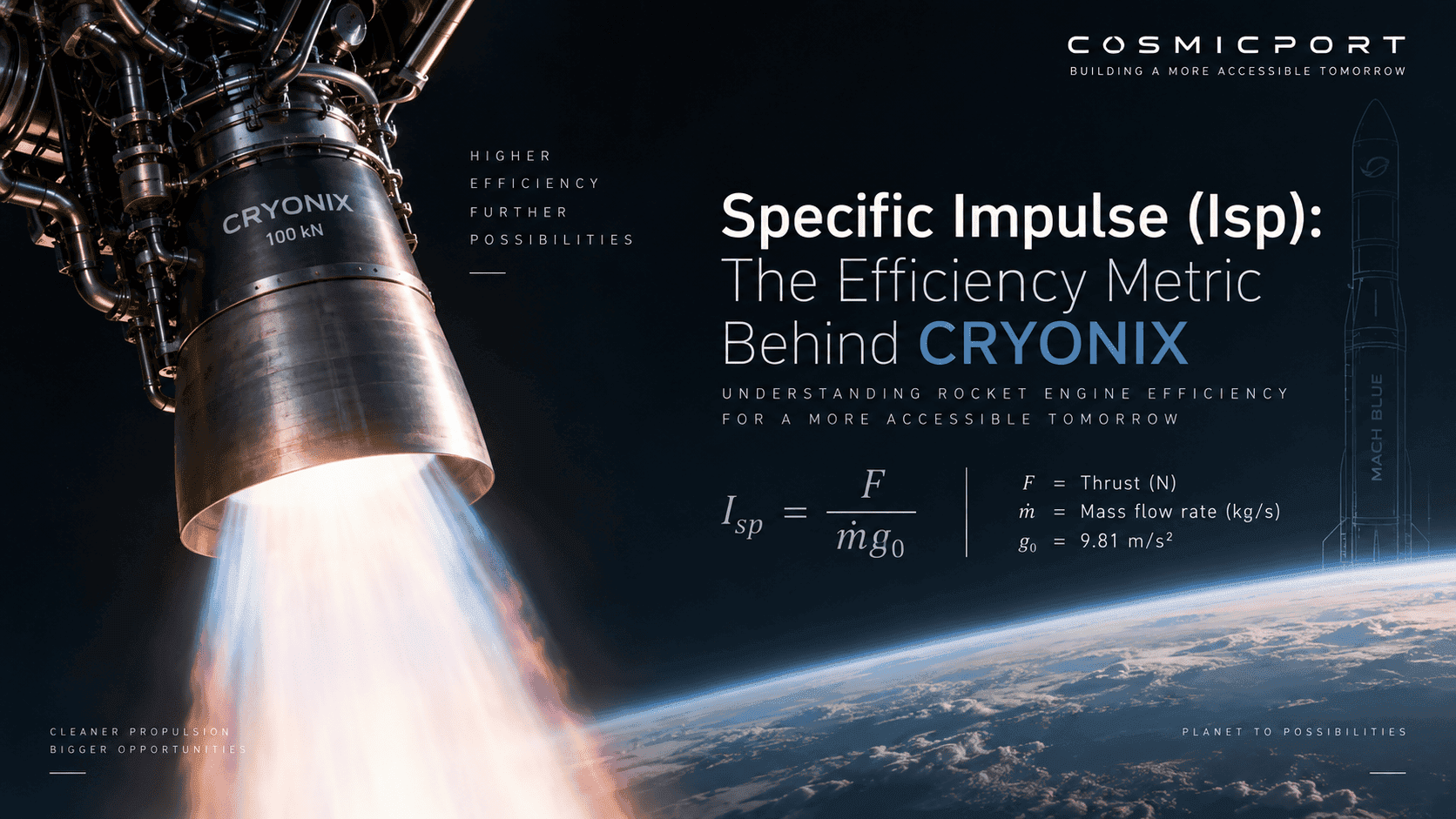
Specific impulse (Isp) measures how efficiently a rocket engine uses propellant to produce thrust. It is expressed in seconds and helps engineers compare rocket engine performance.
When people describe a rocket engine, thrust is usually the first number they reach for. For Cosmicport’s CRYONIX, that number is 100 kN. But thrust alone says nothing about how far that engine can carry a vehicle. Two engines can produce identical thrust while one wrings far more velocity out of every kilogram of propellant. The parameter that captures this is specific impulse, written Isp.
This article explains specific impulse from first principles — what it is, how it is calculated, why it is measured in seconds, and how propellant choice and engine design drive it — and uses CRYONIX, a 100 kN methalox engine, as the worked example throughout. Where it is useful, we derive real engine parameters directly from CRYONIX’s published design figures.
What Is Specific Impulse?
Specific impulse is a measure of propellant efficiency — how effectively an engine converts the propellant it consumes into useful thrust. It is expressed in seconds (s). An engine with higher Isp can sustain useful thrust for longer from the same mass of propellant than an engine with lower Isp.
Crucially, higher Isp does not mean more thrust. Thrust and specific impulse describe two different things: thrust is the force the engine produces, while specific impulse is the efficiency with which it produces that force. CRYONIX is characterised by both — a thrust figure of 100 kN and a design specific impulse of 360 seconds — and the two numbers answer different questions about the engine.
How Is Specific Impulse Calculated?
Specific impulse can be written as:
Isp = F / (ṁ × g₀)
F is thrust, ṁ (m-dot) is the propellant mass flow rate, and g₀ is standard gravitational acceleration (9.81 m/s²). It can equivalently be written in terms of effective exhaust velocity:
Isp = Ve / g₀
where Ve is the effective velocity of the exhaust leaving the engine. This second form is the more physical one: an engine earns its efficiency by throwing mass out of the nozzle as fast as possible. The faster the exhaust, the more momentum extracted per kilogram of propellant.
These relationships let us translate CRYONIX’s headline specifications into concrete engine parameters. Rearranging the effective-exhaust-velocity form, a design Isp of 360 seconds corresponds to:
Ve = Isp × g₀ ≈ 360 × 9.81 ≈ 3,530 m/s
CRYONIX therefore expels its exhaust at roughly 3.5 km/s. And rearranging the first equation for mass flow, ṁ = F / (Isp × g₀), the same engine at 100 kN consumes propellant at approximately:
ṁ ≈ 100,000 / 3,530 ≈ 28 kg/s
At CRYONIX’s fuel-rich methalox mixture ratio (an oxidiser-to-fuel ratio of roughly 3.4–3.6 by mass), that total splits into approximately 22 kg/s of liquid oxygen and 6 kg/s of liquid methane.
CRYONIX — derived from published design specs
• Thrust class 100 kN
• Design specific impulse 360 s
• Effective exhaust velocity ≈ 3.53 km/s (Ve = Isp × g₀)
• Propellant mass flow ≈ 28 kg/s (≈ 22 kg/s LOX + 6 kg/s LCH₄)
• Cycle Gas-generator (open) cycle
These are illustrative figures derived from CRYONIX’s stated thrust class and design Isp, intended to make the physics concrete; exact values depend on the final operating point established through test.
Why Is Specific Impulse Measured in Seconds?
Using seconds for an efficiency metric can seem odd at first, since Isp is not a duration. The unit falls out of the relationship between thrust, propellant weight flow, and standard gravity — the mass and force units cancel to leave seconds. Its real value is that it is universal: Isp lets any two engines be compared on the same scale regardless of size, thrust, or the vehicle they fly on. CRYONIX’s 360 seconds can be set directly against a small thruster or a heavy-lift booster and still mean the same thing.
Why Specific Impulse Matters in Rocket Design
Launch vehicles live under unforgiving mass constraints. Every additional kilogram of propellant a vehicle must carry is a kilogram it cannot devote to payload. Because Isp sets how much velocity is extracted from each kilogram of propellant, it propagates through the entire vehicle design. Higher specific impulse can contribute to:
• Reduced propellant required for a given mission
• Improved mass efficiency across the vehicle
• Greater achievable velocity (delta-v)
• Increased mission flexibility and margin
• Better payload capability for a given vehicle architecture
For CRYONIX, this is the link between the engine and the MACH BLUE launch vehicle it powers: the engine’s efficiency directly shapes how much of MACH BLUE’s liftoff mass must be propellant, and therefore how much payload reaches orbit. But Isp can never be judged in isolation. Thrust, engine mass, chamber pressure, propellant density, combustion stability, thermal management, reliability, and manufacturability all trade against one another. The highest attainable Isp is not automatically the best engineering solution — a point that shapes CRYONIX directly, as the next sections show.
Sea-Level Isp vs Vacuum Isp
A rocket engine’s Isp is not a single fixed number — it changes with altitude. At sea level, exhaust leaving the nozzle pushes against atmospheric pressure, which limits how fully the nozzle can expand the gas. As the vehicle climbs and ambient pressure falls, the exhaust expands more completely, and the engine reaches a higher Isp in vacuum than at sea level. This is why engine data sheets often quote separate sea-level and vacuum figures.
Nozzle geometry is chosen for where the engine will operate. An upper-stage engine, running only in near-vacuum, can use a large expansion ratio optimised for that environment. A first-stage engine cannot: if its nozzle is too large, the exhaust over-expands and separates from the nozzle wall at sea-level pressure, hurting performance and stability at liftoff.
CRYONIX is a first-stage engine. It flies as a cluster of nine on MACH BLUE’s first stage, igniting at sea level and operating up through the atmosphere. Its nozzle expansion ratio is therefore a deliberate compromise — large enough to perform well as the vehicle ascends, but not so large that the flow separates under full atmospheric pressure at liftoff. Its 360-second design figure reflects performance in this booster role, not the larger number a vacuum-optimised nozzle could show on paper.
How Propellant Choice Affects Specific Impulse
Isp is strongly determined by the propellants themselves, because different combinations produce combustion gases with different temperatures, molecular weights, and achievable exhaust velocities. The three common liquid combinations illustrate the trade space:
• Hydrogen–oxygen (hydrolox) delivers very high Isp, but liquid hydrogen’s extremely low density and deep-cryogenic storage force large, heavily insulated tanks.
• Kerosene–oxygen (kerolox) offers high propellant density and decades of operational heritage, but hydrocarbon combustion leaves carbon deposits that complicate repeated firing.
• Methane–oxygen (methalox) sits between the two: strong efficiency, workable density, and clean combustion suited to reusable operation.
CRYONIX’s methalox choice is precisely this balance point — enough Isp to be competitive, propellant dense enough to keep the vehicle compact, and combustion clean enough to support engine reuse. (For the full case for methane–oxygen, see our companion article on methalox propulsion.)
Specific Impulse in Methalox Engines — and Where CRYONIX Lands
Propellant choice sets the ceiling, but the Isp an engine actually achieves depends on how it is designed and operated. The main drivers, and where CRYONIX sits on each, are:
- Mixture ratio. CRYONIX runs fuel-rich (O/F ≈ 3.4–3.6), which lowers peak flame temperature to protect hardware and lightens the exhaust — both favourable for efficiency and durability.
- Engine cycle. CRYONIX uses a gas-generator cycle: a small fraction of propellant is burned to drive the turbopump, and that turbine exhaust is vented overboard rather than passing through the main nozzle. Because that flow does not contribute full thrust, the cycle carries a modest Isp penalty of a few seconds versus a staged-combustion engine — a penalty CRYONIX accepts deliberately.
- Chamber pressure and combustion efficiency. Higher chamber pressure and complete, stable combustion raise Isp; injector and ignition design are central to achieving them, and are validated through test.
- Nozzle expansion ratio and altitude. As above, CRYONIX’s booster-role nozzle is sized for operation from sea level upward rather than for a single peak vacuum figure.
CRYONIX and Specific Impulse
Putting these together: CRYONIX is a 100 kN methalox engine on a gas-generator cycle, with a design specific impulse of 360 seconds — an effective exhaust velocity near 3.5 km/s and a propellant appetite of about 28 kg/s at full thrust. What matters is that these numbers reflect a deliberate balance rather than a chase for a record.
A staged-combustion methalox engine could extract more Isp — but only at substantially higher chamber pressures, thermal loads, turbomachinery complexity, and development risk. CRYONIX’s gas-generator cycle trades a few seconds of Isp for simplicity, robustness, and a faster path to a flight-qualified, reproducible engine. That trade is the right one for its mission: MACH BLUE needs nine identical, reliable, affordable engines firing together — not one exotic, hard-to-build record-holder. 360 seconds is where efficiency, producibility, and program risk balance best.
Specific Impulse and the Rocket Equation
The weight Isp carries becomes clear in the Tsiolkovsky rocket equation, which governs how much velocity a vehicle can gain:
Δv = Isp × g₀ × ln(m₀ / m_f)
Here Δv is the change in velocity available to the vehicle, and m₀ and m_f are its mass before and after burning propellant. Since Isp × g₀ is just the effective exhaust velocity, CRYONIX’s Ve ≈ 3.5 km/s is the multiplier sitting in front of the mass-ratio term — the figure the entire vehicle’s velocity budget is built on. Reaching orbit demands a large delta-v, so the Isp of the engine cluster sets how aggressively MACH BLUE’s mass must be devoted to propellant. Because the relationship is logarithmic in mass but linear in exhaust velocity, even small, hard-won gains in Isp compound meaningfully across the ascent.
Is Higher Specific Impulse Always Better?
Not necessarily — and CRYONIX is a case in point. An engine with extremely high Isp may demand low-density propellants, larger tanks, more complex turbomachinery, or operating conditions unsuited to a particular vehicle. Real launch-vehicle design balances a whole set of parameters at once:
thrust + Isp + engine mass + propellant density + reliability + cost + manufacturability + reusability
The objective is not the highest Isp on a spec sheet. It is a propulsion system that performs best as part of the complete launch vehicle — which is exactly the reasoning behind CRYONIX’s configuration.
Specific Impulse as Part of Launch-System Engineering
Specific impulse gives engineers a standardised way to understand and compare propulsion efficiency, and it connects engine-level decisions — propellant selection, combustion conditions, cycle, and nozzle design — to vehicle-level outcomes like propellant mass, payload, and mission performance.
For a modern methalox system, Isp is one input in a broader balance. Cosmicport’s CRYONIX engine and MACH BLUE launch vehicle are being developed within exactly this system-level view — where propulsion efficiency has to work together with thrust, scalability, operational practicality, and the architecture of the vehicle as a whole.
Explore Cosmicport
Explore Cosmicport's launch vehicle and propulsion technologies.